Thursday, May 11, 2006

Re-Engaging with Museums

Museums generally aren’t my thing. I wish I appreciated art, but unfortunately I can’t really tell the difference between Rembrandt and Renoir, Dali and Degas or Pissaro and Picasso.

Yet last week I went to the Tel Aviv Museum to see an exhibition on the Disengagement. It had various photos from a range of artists and photographers, as well as several videos, one of which followed Arik and Dati Yitchaki and their three children of the Kfar Hayam settlement for a year before the disengagement.

After attracting hundreds of volunteers to help prevent the withdrawal, and armed with two pistols and an M16, Arik finally negotiates with the IDF to hand in his weapons in exchange for being able to leave in a dignified way (which in his case is being carried out by soldiers)

I thought it was pretty fair, but maybe that’s just me being subjective. And it made me wonder how we can talk about political or emotive issues without being biased or political?


boy offering sweets to soldiers during Disengagement


And watching the tears and pain on behalf of the settlers and soldiers the question is how can we put over a complexity that involves describing the pain of the Jews who had to leave their homes whilst simultaneously demonstrating the ‘complications’ Gaza Palestinians faced due to the presence of those Jews; deny with disgust inappropriate comparisons with the Shoah on the one hand, yet have the humanity to identify with fellow citizen’s pain on the other.

Can we feel the tears of families forced to pack their life’s belongings with the harsh truth that an island of 8,000 Jews amongst 1.3 m Palestinians is an anathema to the idea of a Jewish Democratic State; balance the appreciation of the beautiful multicoloured sunrise with the knowledge of the number of soldiers needed to protect those that enjoy it.

How can we resolve the empathy with those feeling betrayed by their government without ignoring the compensation ‘sweetener’ that many blue collar workers supporting a family in Tel Aviv dream of.

When talking about the ‘settlers’ how does one distinguish between those people who had lived in Gaza for 30 years, built lives from the sand and those who came a few weeks before to cause trouble and abuse soldiers. Between those that believe Gd gave us the land and think the Arabs are enemies, and those that came for the cheap housing and the good beaches?

And finally how in a country that doesn’t have a word for subtlety, can these discussions be had in a reasonable and respectful manner, without using words such as occupy or expel?

For anyone who has some spare time in Tel Aviv, the museum is well worth checking out.

Monday, May 08, 2006

Politics, Promises and Hope


Around the same time I made Aliya, the 'big bang' happened in Israeli politics. I am pretty sure it had nothing to do with me, but the creation of a new party, made up of representatives of the right, left, secular and religious publics offered a new direction for an Israeli public tired of political factionalism and instability.

It was supposed to change the political scene, meant to offer hope. It was intended to offer a new way forward for the nation, one large centralist party, representing the silent majority, that could move Israel forward in taking many of the hard decisions that most people think are inevitable. After years of coalition politics, each party claiming its pound of blood for support, here was an opportunity to create a coalition not beholden to the small peripheral parties. A new party, a new hope.

But nothing in Israel goes according to plan.

Whether through tactical mistakes by Kadima, people’s ambivalence or simply strategic voting, the ruling party received only 29 votes, instead of the 40+ they were hoping for or probably would have received had Sharon still been on the political scene They were forced to form a government with Labour, Shas (who demanded 2bn shekels for their own sector without obligating themselves to vote with the government on political initiatives), the Pensioners and probably United Torah Judaism and Meretz.

Last week, the new government was sworn into office. It had the most ministers in history, yet no representatives from the Russian or Druze sectors. There was no place for talented people who had joined politics from the outside Uriel Reichman, head of the IDC university in Herzliya, Avishai Braverman, former head of Ben Gurion University, Ami Ayalon, ex head of the Mossad. Dan ben David, an academic who had big plans for changing Israel's economy didn't even become a MK. Amir Peretz, who has hardly any military experience became Defence Minister. Former Defence Minister Shaul Mofaz is now in charge of Transportation.

What will come of the grand plans to change the education system, fight organized crime or ‘converge’ approximately 60,000 Israeli citizens living in the West Bank with such a shaky coalition? For what was supposed to be the ‘big bang’ most things have sadly remained the same. And so a time we thought was the beginning of hope ended up with things exactly as they were before.…

And then came Yom Hazikaron and Yom Haatzmaut, and the documentaries and articles about the soldiers, the Israeli Jews, Druze, Bedouin, Circassian, Christian and Muslim young men and women that have given the ultimate sacrifice for this country - the stories about the soldier from Neve Dekalim in Gaza who was killed by friendly fire, buried and later disinterred during the Disengagement; the Israeli Muslim father who lost his son and feels he has a pact born out of blood with the Jewish people in this land; the soldier named after his fathers father who was killed in the Holocaust only to be killed in a training accident; the soldier whose pangs of conscience troubled him after killing Hezbollah members in Lebanon and who later refused to serve in the ‘territories’ and how each of these soldiers in their own way represent the rainbow that is the Israeli experience in all its complexity.

And the following night, as I celebrated Yom Ha’atzmaut for the first time as an Israeli, as I walked through the throngs of people, young and old, immigrant and veteran, religious and secular in the centre of Jerusalem, and joined in the Israeli folk dancing outside the municipality (or tried to - its very hard to copy people when you don’t know what you are doing and the song changes every 30 seconds) it reminded me of a younger, more naive, perhaps even more idealistic Israel - when we were still pure from pilots being accused of raping a young girl, or increased violence in schools, an Israel still finding its way, but looking towards the future with optimism and hope.

And as I watched from the sidelines (I gave up the attempted dancing after a short time), I felt that despite it all, there are more things that unite us than divide us, that despite the ever growing Iranian threat, the attempts to formulate more withdrawals from the West Bank without a huge majority, the fact that each party seems to care more about themselves than about the greater good, there are still people here who are ideologues, are still moments when we can come together and remember why we chose to make this place our home. And it reminded me of the song, that we all sing on these sorts of national occasions, “we haven’t yet lost our hope, the hope of 2000 years, to live as a free people in our land, the land of Zion and Jerusalem.”

And we’re not there yet, are a long way from creating the perfect society, but we’re on a journey, and I am part of that journey, and at the end of the day I wouldn’t want to be anywhere else.
If you like this post, please go to www.jibawards.com and vote for it as the Best Overall Post
Monday, April 24, 2006

Yom Hashoah

Today I went to the new Yad Vashem museum - I wasn’t working, am desperately trying to give my empty days some sort of structure, and tonight is Yom Hashoah so it seemed appropriate. Truth is, there's so much to say about the Shoah and none of it is really enough...but I’m kind of glad that all visiting foreign dignitaries get taken there. Because beyond the legitimate questions of whether we are too taken up by our past, and whether by harking on about the Shoah all we do is create negative Jewish identities in our children, the truth is that one can't really understand the way Israel acts without understanding that we lost 6 million of our people so recently - cant appreciate the subconscious fears of Jews that complete genocide by our neighbours is a possibility without visiting a place documenting one of the greatest crimes against humanity carried out by a people that was considered to be one of the most cultured.

And I don’t think one needs to buy into the narrative that it will never happen again cos we have Israel or that we can’t trust the world cos they stood by and did nothing to remember just what type of role this homeland of ours plays. And whilst its not always easy to live here, Yom Hashoah and Yom Ha’atzmaut next week should remind us that life wasn’t always like this, and some of the things we who walk the streets of Jerusalem take for granted were not always so...

And as I walked through the different areas, I remembered this part of Amos Oz's book describing the celebrations of the Partition Plan in 1947 and thought that its really something that Israeli kids nowadays (including those walking around Yad Vashem mucking around or being bored) live a different reality to previous generations...and if for nothing else, this is a reason to give thanks

"And very late, at a time when this child had never been allowed not to be fast asleep in bed, maybe at three of four o clock, I crawled under my blanket fully dressed. And after a while Father’s hand lifted my blanket in the dark, not to be angry with me because I’d got into bed with my clothes on, but to get in and to lie down next to me, and he was in his clothes too, that were drenched in sweat from the crush of the crowds, just like mine (and we had an iron rule; you must never, for any reason whatsoever, get between the sheets in your outdoor clothes). My father lay besides me for a few minutes and said nothing, although normally he detested silence and hurried to banish it. But this time he did not touch the silence that was there between us but shared in it, with his hand just lightly stroking my head. As though in this darkness my father had turned into my mother.


Then he told me in a whisper, without once calling me Your Highness or Your Honour, what some hooligans did to him and his brother David in Odessa and what some gentile boys did to him at his Polish school in Vilna, and the girls joined in too, and the next day, when his father, Grandpa Alexander, came to the school to register a complaint, the bullies refused to return the torn trousers but attacked his father, Grandpa, in front of his eyes, forced him down on the paving stones and removed his trousers too in the middle of the playground, and the girls laughed and made dirty jokes, saying that Jews were all so-and-sos, while the teachers watched and said nothing, or maybe they were laughing too.

And still in a voice of darkness with his hand still losing its way in my hair (because he was not used to stroking my hair) my father told me under my blanket in the early hours of the thirtieth of November 1947, ‘Bullies may well bother you in the street or at school some day. They may do it precisely because you are a bit like me. But from now on, from the moment we have our own state, you will never be bullied just because you are a Jew and because Jews are so-and-sos. Not that. Never again. From tonight that’s finished here. For ever’ I reached out sleepily to touch his face, just below his high forehead, and all of a sudden instead of his glasses my fingers met tears. Never in my life, before or after that night, not even when my mother died, did I see my father cry. And in fact I didn’t see him cry that night either. Only my left hand saw. "(A Tale of Love and Darkness - Amos Oz p346)

Wishing everyone a meaningful Yom Hashoah

Monday, April 10, 2006

Pesach Thoughts 5766: Pesach time and the living is...

As festivals go, Pesach is a good one - The Matza bry, family time, opportunities to see friends, sunbathe…

But beyond that, it’s a festival about freedom – and what freedom means in our day and age. What freedom means when there are people who were forced out of their homes 9 months ago that are still in hotels; or when families who work full time still can’t afford to feed their children, or when young 18 year old Israeli boys are forced to make thousands of people wait in line at roadblocks.

It’s a story of a liberation movement, of slaves who took on the most powerful empire in the world and won, a revolutionary story claiming God is not on the side of the strong but the weak, a message that people can fight injustice even when the odds are stacked against them, a biblical story that still resonates today with people fighting for their independence.

It’s a festival that reminds us of the need to ask questions, to critique, to not take things at face value, a time for not only asking in what way this night is different to others, but in what way our year has been different, or in what way we are different from last Pesach, what we have accomplished since then, who we have met, where we have traveled, who we have helped, who we have hurt…

It’s a festival about education, how we educate and renew ourselves, how we inspire children and how we can best balance the four different types of children within us. As the shechiyanu bracha is said, it’s a time to remember those who were not spared to celebrate this chag, those that came into the world and those that passed from it, and those things that despite all our scientific knowledge, we are still not privileged to understand.

And finally when we say LeShana HaBaah Biyrushalayim, Next Year in Jerusalem, what do we actually mean – what will the next year bring, what will be in this land of ours, with the new coalition, with the Hamas government, with the increasing poverty and social problems?

And amongst all these issues, where will we be, and what will be doing to help solve them?

Chag Sameach Leculam

Sunday, March 19, 2006

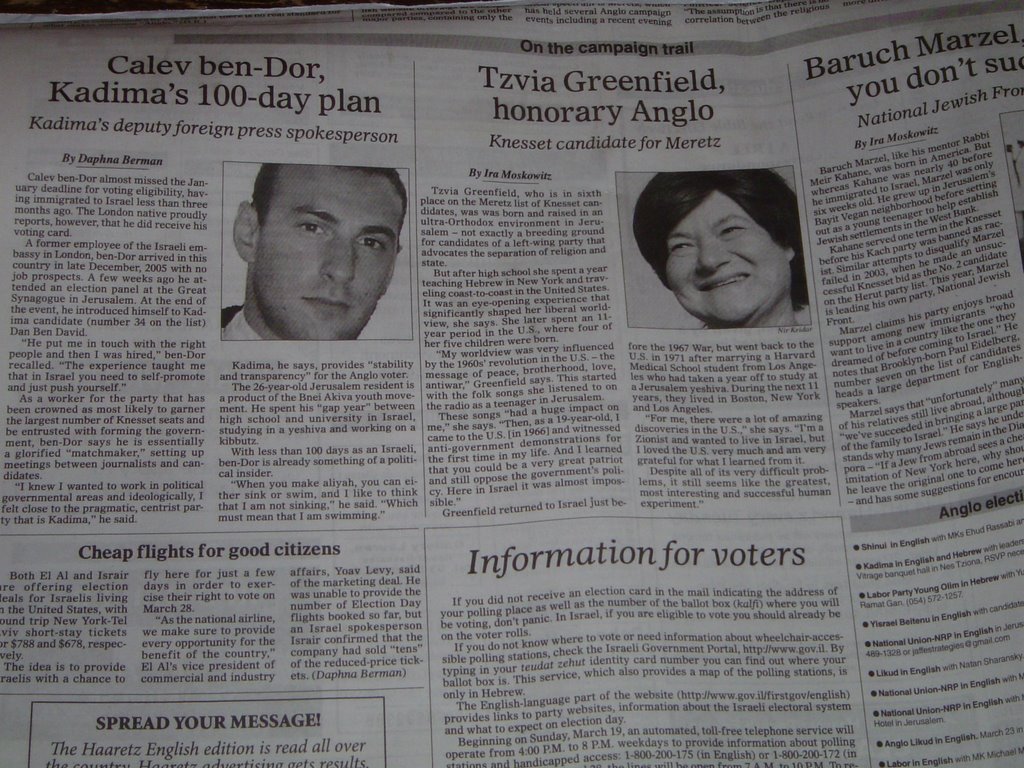
Anglos, Politics and Quotes in Context


This appeared in Haaretz on Friday as part of a feature on Anglos involved in the election where i am proudly included next to an Ultra Orthodox women who is on the Meretz list and a neo fascist who wants to expel all the Arabs...

and for those interested, the last quote was in response to a question about me diving in the deep end of Israeli life...

Monday, March 13, 2006

Purim in Israel

For someone who often confuses the words LeHitchapess (to dress up) and LeHitpashet (to undress / get naked), Purim can potentially be a testing time when asking people about their plans for the festival... and for someone who didn't think of bringing random colourful clothes when they were packing their 75kg for Aliya, the mass panic over what outfit to wear can raise some difficulties.

Yet at the end of the day, Israel is a great place to be for celebrating, even if there are a few too many fairies and cross dressed men (some enjoy that a little bit too much if you ask me - a bit like Purim is an excuse to do those things you always wanted to, but didn’t think you could get away with – and that is perhaps why the real frummers get really really drunk).

Yet seeing Israeli kids walking the streets in costume, store keepers wishing people Chag Sameach and the general enjoyment of a Jewish festival by mainly secular people is one of things that, in my opinion, is special about Israel and that one couldn’t find anywhere else.

So whether it’s the goth like Halloween-gone-wrong outfits sported by some, girls dressing up as monsters in Tel Aviv (I think they were dressed up) or those people i saw today in Bnei Barak that dressed up as Charedim, there are plenty of laughs and fun to be had over Purim.


And if you really want to see something that will make you laugh on this joyous day, please click on the following two links (I know I will regret this, but hey its Purim…)

Wednesday, March 08, 2006

Politics and Arguments

For those who read the first posting on this blog, you would know that it wasn’t supposed to be about politics…But what to do – I live in Israel, its elections in two weeks, its something that everyone talks about, and for the past month I have been working in the Foreign Press Section of the Kadima Party.

I should probably start with a word of warning about those wanting to enter Israeli politics – if you mix in religious Zionist circles, shy away from arguments about politics, and generally don’t like conflict with people, you probably shouldn’t work for Kadima…

But I came to Israel wanting to work in some sort of political / governmental niche, I realized that the elections offered some sort of opportunity, and with a bit of self promotion and noodging of people, I started updating Kadima’s English website and arranging interviews for the foreign press a few weeks after I started at ulpan.

So whilst not wanting to make this blog into party propaganda, i will say that any election campaign that has a full on lesbian kiss in the political broadcasts (Green Leaf - the legalise marijuana party - the headline was 'we have other aspirations aswell') can't be that bad. And if you're not sure who to vote for, this website has come up with an easy way (for ivrit speakers) to decide who to cast their vote for.

enjoy the campaign - and remember that whoever wins, we will probably still be complaining over shabbat dinner about the state the country is in for the forseeable future