Friday, July 21, 2006

Letter to a Soldier

Dear B

After speaking to you over lunch on Shabbat I thought of things I wanted to add (isn’t that always the way.) I am not sure when you will have time to read this, but I hope that basic training goes o.k. and is not too depressing – knowing you, you’ll probably love it! And above all else, I really hope your army experience is everything you want it to be.

On Friday I saw a film called Ulpan life, describing the experiences of 5 different olim chadashim in Israel. One, a Chinese girl called Dong Dong met her Israeli husband on a tiyul and returned with him to set up life in Israel. Dong Dong dreams about making a documentary about Chinese workers in Israel ‘but not about their hardships, something that Israelis always discuss…about their love for this country.’

Yet as she meets the workers and hears their stories she realizes that the awful conditions they experience demand something else – that she films their lives and creates visual testimony to their hardships. And in a passage I found particularly moving she says, ‘Maybe after being here (in Israel) for a few years here I will become numb to all of this; but I don’t want to become numb, I want to do something about it…’

Last week we read about Pinchas who is given a ‘Brit Shalom’ by God after zealously slaying two people engaged in a forbidden act. The Torah’s view on zealotry is ambivalent at best – the line between killing to protect God’s honour and murdering to protect our own is thin according to the commentaries. And why is this man who kills given a Brit Shalom? Because, according to the Netziv, after what Pinchas did, he needed it - the inherent nature of killing people, even if divinely sanctioned, could have left him with feelings of hate.

And I think is being suggested is that killing may sometimes be acceptable, but it leaves its mark on the killer. Because there are things that even if they are right and need to be done, they still have negative consequences.

And the line between killing to defend values we cherish and murder is sometimes blurry at best.

Whilst on a personal political level, I look forward to the day when Israel will be able to leave most of the ‘territories’ I also believe that the army is doing an important, even crucial job. And Kol HaKavod to Tzahal! The job your unit does is essential to us mere civilians being able to sleep safe at night or get on a bus to work safely.

Yet the work they do is also sometimes ugly, sensitive; and over time can take its emotional toll.

It may be necessary to do. But, long bouts of military activity in civilian population centres effects people, wears them down, makes them indifferent to suffering. It can make us numb.

So above all, stay safe, and look after yourself (and don’t listen to those Israelis that will tell you you’re crazy.) And in addition, try and battle the feelings of hatred or indifference that the work you do may naturally lead to. And do your best not to be numb to other people’s suffering (even if they are on the other side to us.)
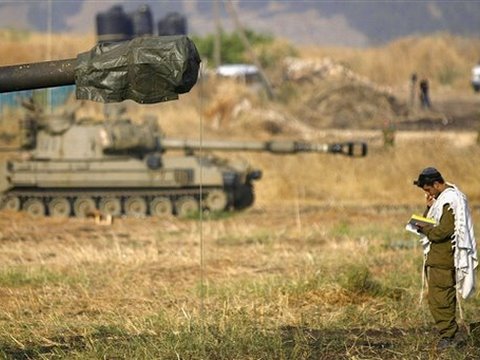
Because our emotions and ability for compassion make us who we are. And none of us made Aliya to ultimately become indifferent to what happens here.

May God give you a Brit Shalom.

Wednesday, July 19, 2006

Nasrallah and the Spider's Web


You know you’ve been watching too much TV when the ‘breaking news’ is neither just breaking nor news. And you know black humour is taking over when you start making a list of ‘top 3 things to take into a bomb shelter’ (do bomb shelters have wireless?)


I spent the last two days in Tel Aviv wondering what I would do if I heard a siren heralding the arrival of a Katuysha. Sitting outside a cafĂ© on Diezengoff, walking in the Azrieli centre, relaxing by the beach…how far can I run in a minute? Where is the nearest bomb shelter or stairwell? Is that a siren, or only cars hooting? Whilst for people in Tel Aviv these questions remain hypothetical, citizens further north, Israeli Jews and Arabs have been spending much of the past week in their Miklat. This war may not yet have a name, but it is actively affecting people’s lives. Sometimes, tragically, it is taking them.


Head of Hizbullah Hassan Nasrallah looked at Israeli society and saw weakness, a spider’s web that seemed strong but could be easily broken, a materialistic culture drunk on its economic success and bending over backwards to appease an unstoppable wave of Islamic nationalism. He saw the unequal prisoner exchanges, the withdrawals to the international border in Lebanon and Gaza, the inexperienced triumvirate of Olmert, Peretz and Chief of Staff Dan Halutz and wanted to test us. And he thought, as spiders webs do, that we would break.

He was wrong.

Because just as the theory goes that only the right wing can make peace, similarly only the left wing can make war. And it tells you something that in a country with no word for consensus, everyone from Lieberman to Livni, from Bibi to Beilin agree that military action against Hizbullah is justified and legitimate. And it’s amazing that in a week in which a million people remain under the threat of rocket fire, there have been no mass demonstrations against the war or no-confidence votes against the government.

Because whilst we wish our relationship with our neighbours was similar to that of France and Belgium, or Finland and Sweden, a post modern borderless world where trade trumps all, we also know that this is the Mid East, not the Mid West, and Switzerlands don’t survive for very long here. Sometimes, we need to fight. And strangely enough, and for the first time in recent memory, I think most countries in Europe (apart from Finland, France, and maybe Switzerland, understand that.)

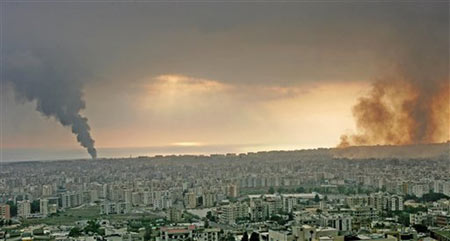
view from Beirut

We may be more individualistic than in the past. We may have given up on the dream of the greater land of Israel, may have decided that being in historical places such as Bet El and Shilo is no longer in the Zionist interest. There may be fewer people going into combat units, and less soldiers turning up for miluim. The dream of many Israelis may be to go to America and make money…but we’re no spider’s web.

We’re a state based on an unspeakable bond. A people drawn together by a shared past and a unified future. A society that may seem weak and unable to decide on national priorities, but in reality one that has red lines that no one is willing to compromise on. And what Nasrallah (and Arafat and Saddam Hussein before him) failed to realise is that you don’t need to be a fundamentalist to have a way of life worth fighting for, don’t need to be an extremist to be willing to make sacrifices for the greater good.

You just need to know that, as the famous Israeli song goes, we have no other land, even if it’s burning.

In the land in the London Times

Wednesday, July 12, 2006

I'm not an academic failure...promise!

The following conversation took place this morning between me and someone who works for a strategic consultancy firm in Tel Aviv. I hope its 'success' will not be reflective of my general search for jobs.

Hi Calev?

Yes

Hi this is Shelly from ****. You spoke to Sharon before; I have your CV in front of me, I just wanted to ask you a few things

Sure

I wanted to ask you what mark you got in your psychometric?

Well actually I didn’t do a psychometric – I am an oleh from England but I do have a Masters degree.

o.k – well what did you get in your SATs ?

well we don’t do SATs either; what we have in England is GCSE’s which you take in 10 subjects when you are 16, and also A levels which you take in 3 subjects when you are 18. According to those marks you are accepted into university.

o.k – well what was your average mark

Well, GCSEs and A levels don’t actually have marks, they are A, B, C etc. I got good GCSEs and A Levels and what is called a Merit from LSE, the London School of Economics

Oh, I haven’t heard of that

Sorry?

Just personally, I haven’t heard of that

Oh, because a lot of Israelis go there, and its considered to be a pretty good place

Oh, well anyway, what was your average mark?

So in Leeds, where i got my first degree, they have the following grades; a First, which is like 70 and above, a 2.1 which is 60 and above, and a 2.2 which is 50 and above. But 70 isn’t like 70 in Israel, (where if you get 70 you cry and retake the exams) its more like 90 something. And 60 is more like 75. In a Masters degree its graded slightly different - Distinction, which is 70 and above (in fact at LSE you needed to get two distinctions and two merits to get a distinction but i didnt mention that), Merit which is 60 and Pass which is 50. I got about 67 which is considered good in England.

o.k – well I am not really sure how we should proceed, because we don’t actually know how good your marks are. We will have to get back to you in a couple of days

o.k – have a good day

Another job I am looking at requires I pay them 250 shekels and provide a guarantee of 5000 shekels (for which i need to pay the bank 460 shekels)…and that’s only to be considered for the position in the first place!


Strange place this land of milk and honey...

Friday, July 07, 2006

Gaza, Entebbe & Israeli Weddings

As Israel holds its collective breath for Cpl Gilad Shalit who was kidnapped from his base inside Israeli territory near Gaza two weeks ago, it is perhaps ironic that 30 years ago this week Israel staged one of the most remarkable rescue attempts ever made, where special forces rescued over 100 passengers who had been taken to Entebbe Uganda by Palestinian terrorists. As the hostages came back to Israel thousands thronged the streets in celebration.

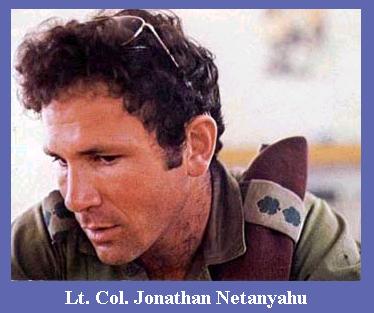
The feeling in the aftermath of the operation in which team leader Yoni Netanyahu had been killed was described in a Jerusalem Post feature as being mixed; “...Early the next day, Sayeret Matkal attended with thousands of others, Yoni Netanyahu’s funeral. The state was in a rare moment of simultaneous elation and mourning.”

A couple of weeks ago I went to a wedding of an Israeli friend of mine from my year off called Elad. It was a real Israeli wedding – the hall was in a place I had never heard of (somewhere near Bet Lid), no one wore a suit, lots of people ate and spoke during the ceremony and the photographers got way too close to the couple under the chuppah…

Quite a few friends from yeshiva were there; Roi, Dov, Hed, Adiel, Shlomi, Ori; some with wives, some without. Amongst those I hadn’t seen for a while was someone I used to play football with during lunch time, Yoni Ashchar. After returning from a trip abroad, Yoni had suddenly collapsed whilst playing basketball and fell unconscious for a few minutes. He is making unbelievable progress but no one knows what sort of final recovery he will make. Another guest at the wedding from our year in Ein Tzurim had lost a brother in a army training accident. In addition, the parents of our friend
Danny Cohen who was killed whilst on service in the IDF also came. (Like Gilad Shalit, Danny also had an uncle who was killed in the Yom Kippur War.)

And as I found myself the sole Brit amongst Israelis, I wondered whether my peers at Ein Tzurim were actually in some way representative of Israeli society at large. Because from amongst those who I shared good times and bad throughout our 8 months on a small yeshiva and kibbutz near Ashkelon, one is no longer with us. And from those that are, many carry either physical or emotional wounds from their experiences in this State of ours.

And I started to think that perhaps being in a state of ‘simultaneous elation and mourning’ as the Jerusalem Post described is perhaps not as rare as we may have thought. Because even at the height of joy, there is always something missing, somebody who should be there but isn’t. Even at our happiest moments we remember Jerusalem’s destruction; even at a wedding we can’t ignore those who will never wed. Even Entebbe had its price.

And maybe that’s what being in this country is supposed to be about…never being absolutely complete, but going on and rejoicing nevertheless.

What will happen to Gilad no one yet knows, with some experts saying that staging a rescue operation is even more complicated than that carried out 30 years ago in Uganda. Yet in a week where Kassam rockets hit Ashkelon for the first time, and Israel buried its first casualty since the Gaza incursion, I couldn’t help but be nostalgic for the aftermath of Entebbe, even if its results dictated the emotionally difficult balance of simultaneous rejoicing and mourning.

Sunday, June 18, 2006

The Mondiale & Pride in Unexpected Places

Watching the world cup in Israel isn’t easy. For someone used to Hansen’s tactical astuteness, Lineker’s witticisms and the general professionalism of the advert free BBC, it takes some time to acclimatize to the 4 Israelis sitting in comfortable chairs watching the game on a big screen and commentating.

They have interviewed Septuagint ex politician Tommy Lapid (he was born in the former Yugoslavia – a clear expert on the Serbian team apparently) an Israeli grandmother whose claim to fame was that her husband had got her tickets to the Holland – Serbia game (she wanted Serbia to win cos the players were in the hotel with her and they seemed nice) and the only phrase that Avi Nimni the former footballer and Israeli commentator says in ‘Yotze min HaClal’ out of the ordinary (over and over and over again…) Their piece de resistance was the inability of one of the commentators to pronounce the name Milosevic correctly.


So when people say Aliya means making sacrifices, they perhaps should be clearer about what it means…

But every now and then, something happens that reminds you why you are proud to be an Israeli. And during Ghana’s celebrations after their second goal against the Czech Republic yesterday, I’m not sure I would have wanted to be watching anywhere else.

3 Ghanians play in the Israeli league

Monday, June 05, 2006

Energy and Emotions in Etzion

I’m the sort of person who likes doing fun and interesting stuff, but often ends up staying at home watching videos. So when last week, a friend from LSE suggested we do a tiyul and field trip to the Etzion bloc and settlements further to the East, and that he was doing all the organizing, it was an offer too good to refuse.

Gush Etzion area comprises in total approximately 44,000 Jews and 18,000 Palestinians and the western half of it is generally seen to be in the Israeli consensus (if there is such a thing) of what will remain part of Israel in a future peace deal.

We started at Kibbutzim Rosh Tzurim and Kfar Etzion, visited Bat Ayin (and its smaller offshoot Bat Ayin Bet and outpost of one family, Old Masuot Yitzchak) stopped in Efrat for some pizza, continued east past Palestinian villages to reach Tekoa (whose Rabbi Menachem Froman has stated he is prepared to become a Palestinian citizen in a future Palestinian state and met with Arafat many times), Nokdim (where Avigdor Lieberman lives) and then on to the Ma’aleh Rechavam outpost, named after the former transport minister Rechavam Ze’evi who was murdered by the PLFP in 2001.

On our way back to Jerusalem (a potentially 7 min drive from Nokdim) we stopped at Neveh Daniel (and Neveh Daniel North also known as Sde Boaz, the highest point in Gush Etzion)

I have to admit to not being a fan of settlements.

I believe the Jewish people have a right to all the land, both for religious, historical and cultural reasons.

But at the end of the day, if we want a two state solution between the river and the sea that doesn’t involve transferring millions of Palestinians out of their homes, many settlements will have to be evacuated.

And whilst I won’t pretend to be one of those who since 1967 warned of the danger of settlements and definitely used to be more ‘right wing’ than I am now, I have come round to the opinion that doubling the Jewish population over the Green Line during the Oslo years, or building settlements painfully near Palestinian population centers under Begin and Shamir was a mistake of potentially cataclysmic proportions.

And the day the settlements make a viable Palestinian state impossible, is the day that Zionism enters a very dangerous new stage in trying to maintain its Jewish democratic character.

However, whilst these settlements may be potential ‘obstacles’ to peace, they’re damned beautiful…

Sde Boaz by Neveh Daniel is environmentally friendly; it’s a mixed religious and secular community; it was built by Avoda Ivri, (Jewish labor) instead of relying on cheap Palestinian, Thai or Romanian workers; it grows wheat, chickpeas, chard and beets and olive and fruit orchards surround the community. On a clear day you can see the Mediterranean and the dead sea.

When we arrived at Ma’aleh Rehavam meanwhile, five young people were planting trees.

The air was clear, it had a feeling of pioneering, of naivety, of romanticism, of imagining that this is actually where Avraham walked on his way to the binding of Yitzchak;

Like here were people living by their ideals, for a purpose they believed in, who had given up the big lights of the city to create a community they could be proud of.

And strange as it was for two centre-left international relations graduates to imagine, the outposts were strangely attractive, enticing, a hark back to early chalutzim that we so admire.

And this is where everything turns on its head – because for years Zionism was about building, planting, establishing – and where the last settlement was would be where the border would run.

And in this sense, these young people are carrying on the Zionist dream and ethos more than any of us…

Yet somewhere along the line, this essence of Zionist became its mortal enemy – and the more we build and plant and establish, the less chance we have for saving what we all came here to help strengthen – a Jewish democratic state.

Somewhere along the line, a Palestinian state moved from being an existential threat to the only solution to Zionism. And in addition to the atmosphere of serenity, purity and ideology in parts of the ‘territories’ there has slowly spread an increasing lawlessness, hatred for non Jews and ambivalence towards the democratic government and its law enforcers…

And as the sun set behind us I couldn’t help thinking about the
hundreds of millions of dollars, and the hours, days and years of energy that people have spent creating an enterprise that ultimately will be destroyed (which will most likely also cost billions of dollars.)

And whilst we'd all be better off harnessing some of these young peoples’ energy and idealism in what is becoming increasingly like a cynical post zionist state, I question whether in retrospect it may have been wiser and less soul destroying to build such ideologically oriented places such as Ma’aleh Rehavam and Sde Boaz 20 km further south in the Negev rather than in the Judean hills, on land that will probably become part of a Palestinian state.

Thursday, May 11, 2006

Re-Engaging with Museums

Museums generally aren’t my thing. I wish I appreciated art, but unfortunately I can’t really tell the difference between Rembrandt and Renoir, Dali and Degas or Pissaro and Picasso.

Yet last week I went to the Tel Aviv Museum to see an exhibition on the Disengagement. It had various photos from a range of artists and photographers, as well as several videos, one of which followed Arik and Dati Yitchaki and their three children of the Kfar Hayam settlement for a year before the disengagement.

After attracting hundreds of volunteers to help prevent the withdrawal, and armed with two pistols and an M16, Arik finally negotiates with the IDF to hand in his weapons in exchange for being able to leave in a dignified way (which in his case is being carried out by soldiers)

I thought it was pretty fair, but maybe that’s just me being subjective. And it made me wonder how we can talk about political or emotive issues without being biased or political?


boy offering sweets to soldiers during Disengagement


And watching the tears and pain on behalf of the settlers and soldiers the question is how can we put over a complexity that involves describing the pain of the Jews who had to leave their homes whilst simultaneously demonstrating the ‘complications’ Gaza Palestinians faced due to the presence of those Jews; deny with disgust inappropriate comparisons with the Shoah on the one hand, yet have the humanity to identify with fellow citizen’s pain on the other.

Can we feel the tears of families forced to pack their life’s belongings with the harsh truth that an island of 8,000 Jews amongst 1.3 m Palestinians is an anathema to the idea of a Jewish Democratic State; balance the appreciation of the beautiful multicoloured sunrise with the knowledge of the number of soldiers needed to protect those that enjoy it.

How can we resolve the empathy with those feeling betrayed by their government without ignoring the compensation ‘sweetener’ that many blue collar workers supporting a family in Tel Aviv dream of.

When talking about the ‘settlers’ how does one distinguish between those people who had lived in Gaza for 30 years, built lives from the sand and those who came a few weeks before to cause trouble and abuse soldiers. Between those that believe Gd gave us the land and think the Arabs are enemies, and those that came for the cheap housing and the good beaches?

And finally how in a country that doesn’t have a word for subtlety, can these discussions be had in a reasonable and respectful manner, without using words such as occupy or expel?

For anyone who has some spare time in Tel Aviv, the museum is well worth checking out.