Thursday, November 09, 2006

The only parade in the village


Much has been written this past week about the Gay Pride parade that is due to take place tomorrow in Jerusalem. Yet in many ways the argument is over more than just whether members of the ‘homeo lesbit community’ as they are called here, have a right to walk through parts of Jerusalem – it touches on what it means to live in a Jewish and Democratic State not governed by Halacha.

Every democracy has to be based on some sort of compromise between universalism and particularism, between the freedom to do how we please on the one hand and the importance of not harming or offending others on the other - or in Israel's case between the values of equality and traditional Jewish custom. And it leads to legitimate questions over the location of the event, whether we should use our understanding of the Torah as an objective moral compass, or whether it’s consistent that a fuss is made over an annual gay parade whilst weekly public Shabbat desecration at Teddy Stadium is ignored.

Last week someone graffitied a shul in Tel Aviv with the words ‘if we don’t march in Jerusalem, you wont walk in Tel Aviv.’ And whilst vandalising any place of worship is completely unacceptable, it raised an interesting point; because if being outwardly gay in the holy city of Jerusalem is offensive, maybe being openly religious in the secular and hedonistic city of Tel Aviv is equally unacceptable. And if a parade in November in Jerusalem can cause tyre burning and kabbalistic curses, what might Simchat Torah in Tel Aviv lead to…

But one thing is certain – the moment any event is cancelled due to fear of aggression and threats, we find ourselves on an extremely slippery slope. Because what message does it give to people unhappy with the decision making structure of the State? And if a parade can be cancelled by violence, then so can any other controversial policy – whether that’s throwing away Ethiopian (and British) blood, discrimination against Israeli Arabs or evacuation of settlements and outposts. Because the moment people think change can be affected better by crisis than by compromise, by demonisation rather than by dialogue, Israel is in danger of becoming a country that is a lot more dangerous to live in.

And regardless of one’s sexual or religious orientation, that’s not good news for anybody.

Tuesday, October 31, 2006

The Mamluks, Crusaders and our Future Here

I generally received positive feedback from my conversations with two Lebanese about the conflict over the summer. Yet where people disagreed was when I expressed the fear that my grandchildren would not live in Israel because Israel might not exist. Not optimistic I know, but many Israelis have a deep seated fear that our presence here isn’t as permanent as we may like. In England, the question is often whether our grandchildren will be Jewish. In Israel perhaps it should be whether our grandchildren will be Israeli – and whether in 50 years time there will still be a state to live in.

Last week I visited an exhibition at Migdal David, David’s Citadel called Soundscapes, a musical production integrating an archeological site, music, design and technology. The walls were alight with color, and the views were beautiful. Surrounding us was the city of Jerusalem - on the one hand, Israel indivisible eternal capital, on the other, a place captured and lost by vast empires and powerful armies. The Muslims and the Ottomans ruled here for 400 years each. The Romans, Byzantines, Mamluks and Crusaders all ruled for over a century. Even the ill fated Hasmonean dynasty was around for longer than modern day Israel. So what gives present day Jerusalmites the confidence that we will always be a free people in our own land?

In the aftermath of this summer's war, the discussion of our future here seems to have been increasingly discussed. Nobel prize winner Professor Yisrael Auman, a vocal critic of Disengagement, recently claimed that unless Israelis wake up from their slumber the State won't survive another 50 years. ‘Fatigue, in the State of Israel's situation, will lead to death, as occurs with mountain climbing. If a mountain climber is caught on the side of a mountain and it starts to snow, if he falls asleep, he will die. He must remain alert…We are too sensitive to our losses, and also to the losses of the other side...In the Yom Kippur War, 3,000 soldiers were killed. It sounds terrible, but that's small change.’ In a similar vein to Aumann, Effi Eitam leader of the National Union created waves when he discussed how Israel should respond to future attacks on our civilian population questioning whether as a country we are cruel enough to really hit back at our enemies civilian centers if they threaten ours.

At around the same time, the weekend supplement carried an interesting but somber article about Dr Yitzchak Yifat, the main protagonist in one of the most emotive photographs for Jews in the last century – the picture of the paratroopers at the Western Wall in 1967. Dr Yifat, who despite being in his 60’s still comes regularly for reserve duty is particularly pessimistic about the future of the country and for years has been campaigning for an Israeli withdrawal from the West Bank. Talking about what he saw as a debacle in Lebanon, Yifat stated,
‘the one thing that will fix this country is to take a bulldozer and completely turn it over; everything here is built on crookedness and needs to be rebuilt anew.’

I drove past a sign today proclaiming that ‘Jerusalem is not Sodom’ the biblical city that was destroyed due to its lack of social justice and perversity. The message was intended as a demonstration against the upcoming Gay Pride event in the capital; But reading today’s headline in Yediot Acharonot entitled
‘Protest, Gays acting like beasts’ it made me wonder about the future of this city and its inhabitants - and whether we can actually be so dogmatically certain about what this land wants from us, and what type of behavior typifies Sodom in the 21st century.

Our prophets warned us that the land doesn’t tolerate injustice, that we will be spat out if we fail to create a society that is befitting of the name…but who is our modern day prophet – Yisrael or Yitzchak, the professor or the doctor, the nobel or the poster boy? Are we too sensitive, or not sensitive enough? Was disengagement a step in the right direction or the beginning of the end? Should we be more parochial or universal, more western or Jewish, promote or oppose Gay Pride in Jerusalem; Should we spend more time negotiating peace or preparing for war?

And the question that lingers, like the various calls to prayer in our capital, is what if, what if we get it wrong, what if we make the wrong choice?

Monday, October 30, 2006

Jerusalem or Tel Aviv?

In light of my move this week from Jerusalem to Tel Aviv to start work at Reut, a non partisan, non profit political think tank, I thought that this short contrast of the two cities by Amos Oz would be relevant...

Over the hills, far away, the city of Tel Aviv was also an exciting place from which came the newspapers, rumors of theaters, opera, ballet and cabaret, as well as modern art, party politics, echoes of stormy debates and indistinct snatches of gossip. There were great sportsmen in Tel Aviv. And there was the sea, full of bronzed Jews who could swim. Who in Jerusalem could swim? Who had ever heard of swimming Jews? These were different genes, a mutation. Like the wondrous birth of a butterfly out of a worm.

There was a special magic in the very name Tel Aviv. As soon as I heard the word ‘Telaviv’ I conjured up in my minds eye a picture of guy in a dark blue singlet, bronzed and broad shouldered , a poet worker revolutionary. A guy made without fear, the type they called a Herveman, with a cap worn at a careless yet provocative angle on his curly hair, smoking Matusians, someone who was at home in the world, all day long he worked on the land, or with sand and mortar in the evening he played the violin, at night he danced with girls or sang them soulful songs amid the sand dunes by the light of the full moon, and on the early hours he took a handgun and a sten out of its hiding place and stole away into the darkness to guard the houses and fields.

In Jerusalem people always walked rather like mourners at a funeral, or latecomers at a concert. First they put down the tip of their shoe and tested the ground. Then once they had lowered their foot they were in no hurry to move it; we had waited two thousand years to gain a foothold in Jerusalem, and were unwilling to give it up. If we picked up our foot someone else might come along and snatch our little strip of land! On the other hand, once you have lifted your foot, do not be in a hurry to put it down again; who can tell what menacing nest of vipers you might step on. For thousands of years we have paid with our blood for our impetuousness, time and again we have fallen into the hands of our enemies because we put our feet down without looking where we were putting them. That is, more or less, the way people walked in Jerusalem. But Tel Aviv – wow! The whole city was one big grasshopper. The people leaped by, so did the houses, the streets, the squares, the sea breeze, the sand the avenues, and even the clouds in the sky.


Amos Oz - A Tale of Love and Darkness p7

Thursday, October 19, 2006

Emek - Good for Coffee, Bad for Sheruts

Living in Emek Refaim is great. The cafés, restaurants, bars, shuls, friends - all accessible and within a short walk. It’s often buzzing with people and is a fantastic location in Jerusalem…that is until you need to catch a Nesher Sherut back from the airport.

The idea behind a Sherut is a good one – lots of people want to go to the same city, so take them in one minibus and it will be collectively cheaper and better for everyone…that’s the idea anyway.

In practice things were slightly different. First up was being bumped off the first waiting Sherut despite being told there was space for two. Then came the trek to Jerusalem in rush hour…and two hours later, after two stop offs in Har Nof, Ein Karem, back to the central bus station to drop off a non Jewish well meaning Irish women, the town centre for this old Israeli shvitzer (you know, grey chest hair coming out of the shirt) who boasted about how much money he made in New York, and a part of Katamon for a nice French girl, we finally arrived back in Emek Refaim where the driver tried to short change me.

We had been chatting for a few minutes so I was surprised he would try and rip me off –

‘I thought you would be happy to mevater al zeh’, to give up on the change, he said.

So basically you never give people the correct change unless they specifically ask for it?’

‘Of course - why not!’ he replied smiling, giving me my correct change.

Welcome back to Israel - not always an easy country to live in, sometimes quite unforgiving and Middle Eastern. Returning after time abroad sometimes feels like being thrown into a cold shower and getting a slap across the face. Sometimes it’s just relentless in terms of the noise, the behavior, the culture, where to succeed you need to be constantly aware and not mevater on any of your rights;

But its feels strangely good to be back…

Friday, October 13, 2006

Am I an Israeli in LA?

LA – a bustling city of 4 million people; a place of doggie bakeries, lots of traffic, too many coffee options and women with plastic surgery. The home of Hollywood, Beverly Hills, CTU and the Fresh Prince of Bel Air. A place where seeing snow is an once a year occurence in the local park.

The last week here has been particularly busy - The bike riding and rollerblading along Santa Monica beach, with the painfully out of tune busker playing Beatle songs and randoms talking about Jesus, the trip to universal studios and meetings with Wolverine and Shrek (I think they were dressed up) as well as a day out in the Joshua Tree National Park (U2 1987).

The Park is an immense area comprising almost 800,000 acres and incorporating two deserts, – the Colorado and the Mojave (24 Season 2.) Yet what struck me most was simply the enormity of all these areas – how a return trip from LA was the equivalent of traveling from Eilat to Metulla – how the national park itself was larger than Jerusalem, Tel Aviv and Haifa combined and what good use we could put all that space towards if we had it instead.

The Park itself is beautiful, and even though I didn’t catch any glimpses of a coyote or Road Runner, the Joshua trees, massive boulders and beautiful views made it a great day. Yet as we went up to Keys Viewpoint, located along the ridgeline of the Little San Bernardino mountains which form the southern edge of the park, I couldn’t stop thinking about the fact that ‘our’ Machtesh Ramon in the Negev is actually just as if not more impressive and beautiful (and it doesn’t have smog or annoying German tourists illegally feeding desert squirrels there either)

And I also wondered whether that kind of thought made me a true Israeli, or whether a genuine Israeli would actually wish they could make Aliya to Los Angeles?

Friday, September 22, 2006

Rosh Hashana 5767

Rosh Hashana is a time to take stock, a time for self reflection. A time to think about whether we have become the type of people we wanted, whether we are achieving what we set out to achieve;

Rosh Hashana is for me more than just making a new year’s resolution of being less addicted to the internet and not picking my nose in public. It makes me think about what I have done this year, what have I achieved and what I have seen. The people I’ve met and those I’ve lost touch with; the people I’ve helped and those I’ve hurt. It brings me back to the time when I nearly had a panic attack on the other side of the world, being a witness at Adam’s wedding, making Shabbat with 13 Israelis in Chile, leaving England and arriving in Israel for the first time as an oleh, being published in the jpost, meeting Rachel, celebrating with Kadima on election night, interviewing for jobs in Hebrew…the weddings, births and funerals; the times when I felt free and liberated, and the times when my self esteem was low.

And its not just individuals who our tradition says are judged but countries. What does the new year bring for Israel? How many civilians and soldiers will not celebrate next Rosh Hashanah? Will there be more elections? Will the social gap decrease? Will our neighbours finally accept us in the region? Will there be another Disengagement and talk of civil strife?

In addition, it’s also a time of hopes for the coming year; And for me, there can be no greater hope than that of
David Grossman who wrote the following in memory of his son Uri, a tank commander killed just before the cease fire in Lebanon came into effect;

I fervently hope that we will know how to be more tender toward one another. I fervently hope that we will succeed in extricating ourselves from the violence and hostility that have seeped so deeply into all aspects of our lives. I fervently hope that we will know how to straighten up and save ourselves now, at the very last minute, because very hard times still await us.


Uri was a very Israeli child; even his name is so Israeli and so Hebrew. He was the essence of Israeliness as I would want to see it. The Israeliness that has almost been forgotten. The Israeliness that is sometimes considered almost a curiosity. And he was a person with values. This word has been much eroded and has been ridiculed in recent years, because in our crazy, cruel and cynical world it is not "cool" to be a person of values, or to be a humanist, or be truly sensitive to the other's distress, even if the other is your enemy on the field of battle. But I learned from Uri that it is indeed both possible and necessary. That we indeed need to preserve our soul. To defend ourselves in both senses: both to protect our life and to preserve our soul. To insist on defending it from simplistic might and simplistic thinking, from the corruption that lies in cynicism, from the pollution of the heart and the scorn for human beings that truly represent the biggest curse for everyone who lives his whole life in a disaster zone like ours.

And whatever happens in the next year, atleast I feel that I am in the right place to appreciate it, inside the ring fighting rather than looking in from the outside.

Shana Tova Leculam

Wanna Live like Common People


I first met Ohad in the quaint and beautiful town of Pucon in Chile. Arriving at the travel agency to organize my climb up Mount Villarica, I had got chatting to two guys, one with dreads, one with long hair; both clearly Israeli. I later bumped into them again in a youth hostel in Southern Chile and continued with Ohad back into Argentina. A few days before I left for England, he got called up for reserve duty.

Over cookies and coffee in my apartment in Jerusalem we discussed the war in the north; how motivation amongst soldiers was initially high, how almost everyone who was called up came. Ohad spoke of the disorganization – of being told to walk a distance of 15km to clear a road only to be overtaken half way through by soldiers on trucks; of getting ready for numerous missions only for them to be cancelled at the last minute. Of how, as time went on, soldiers began to lose faith in the system and to demand answers that no one could give them; Of how some units were even lacking water.

The balagan in the IDF didn’t end there. A recent report claimed a dangerous mission in Bal–Bek involving 200 elite soldiers as having been undertaken simply for morale. Ben Caspit in Maariv wrote of how an army general, Ron Tal, who had written a critical study of the IDF before the war, had been fired.

Rosh Hashana is about taking responsibility, both personal and national. But what does it say about our leaders when all plan to stay put? Or when previous Ministers are dishing out the blame like they are completely innocent of our complete logistical unpreparedness? What type of country is it when a population that overwhelmingly rejected Netanyahu 4 months ago would now want him back as prime minister or when Yom Hadin might actually literally be a day in court for some of our politicians?

Israel goes into 5767 with increasing social gaps, with an unstable government only 6 months after the elections; with a President facing impeachment and with the threat of a looming nuclear Iran.

Yet whilst the leaders may be refusing to take responsibility, normal people continue to do their bit and step up to the plate. And despite 60% of people saying this week that the country is not in a good state, 88% of Israelis say they are very happy here! Last week I went to the swearing in ceremony at the Western Wall of one of my tour chanichim, Barry. I am not sure whether my post modern sensibilities will ever feel comfortable hearing people swearing allegiance to their homeland. I doubt I will get used to 18 year olds waving their guns around, or the fact that young boys continue to lose their youth protecting our society. But what can one say when in a place that 40 years ago we didn’t have? And how can one argue with militarism in society when 60 years ago our people were marched to the gas chambers?

And all of these people, they aren’t fundamentalists; many aren’t even ideologues; they’re just normal people, students and professionals, fathers and husbands, who leave their normal life to defend our state. And many may have lost confidence in the political leadership, may feel that the army has let them down. But they will continue to come, will continue to answer their tzav shmone to serve and defend. They are people who continue to believe in the Jewish state as an idea, even at times when that concept is harder to justify.

The Haftara we read on second day Rosh Hashana talks about an Am Seridei Charev, a people
who have survived the sword coming back to the land and describes the day when men and women, young and old will dance happily in the streets, a people whose mourning has been turned into joy. And in many ways I do wish that this country was more like Chile, with its quietness and peacefulness, without the fear of war, or tragedy hovering over it. But if the question is whether our cup is half full or half empty there can only really be one answer.

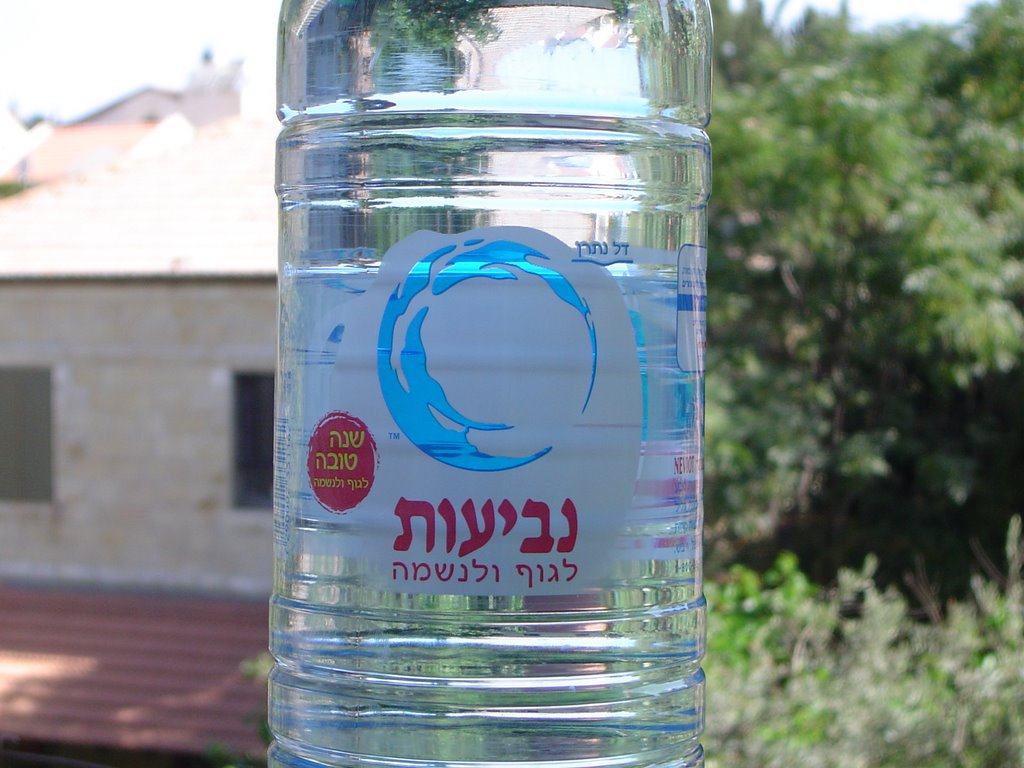
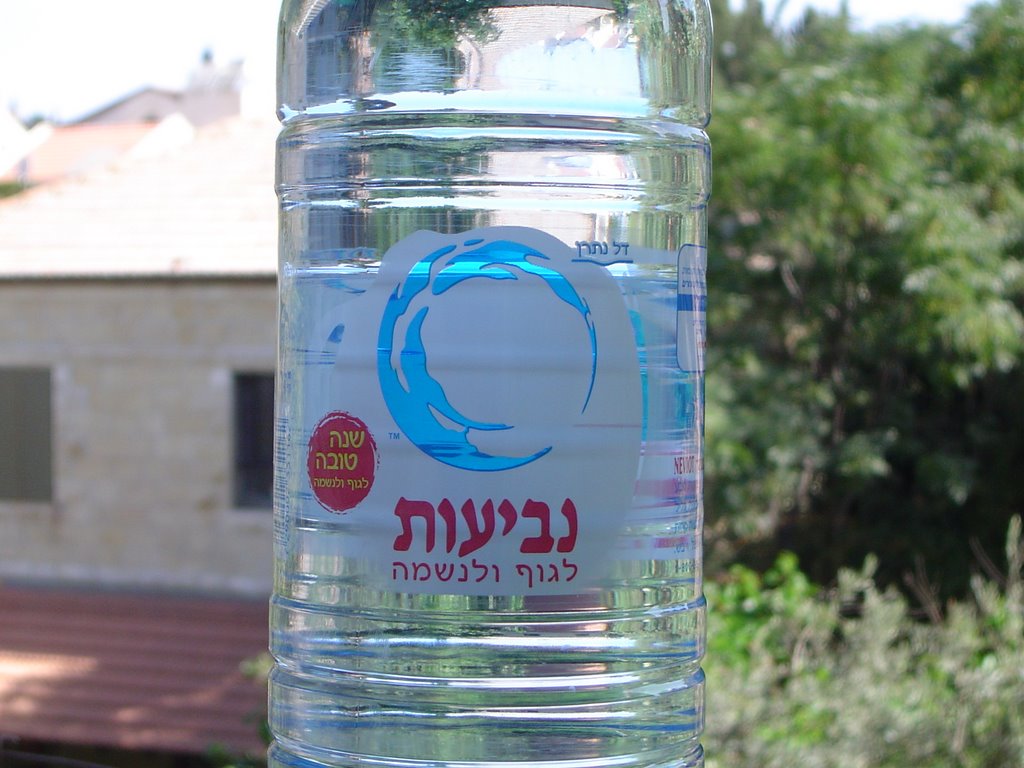
And where else in the world can you buy a bottle of water that will wish you a shana tova leguf uleneshama, a happy new year for body and soul?