Sunday, June 18, 2006

The Mondiale & Pride in Unexpected Places

Watching the world cup in Israel isn’t easy. For someone used to Hansen’s tactical astuteness, Lineker’s witticisms and the general professionalism of the advert free BBC, it takes some time to acclimatize to the 4 Israelis sitting in comfortable chairs watching the game on a big screen and commentating.

They have interviewed Septuagint ex politician Tommy Lapid (he was born in the former Yugoslavia – a clear expert on the Serbian team apparently) an Israeli grandmother whose claim to fame was that her husband had got her tickets to the Holland – Serbia game (she wanted Serbia to win cos the players were in the hotel with her and they seemed nice) and the only phrase that Avi Nimni the former footballer and Israeli commentator says in ‘Yotze min HaClal’ out of the ordinary (over and over and over again…) Their piece de resistance was the inability of one of the commentators to pronounce the name Milosevic correctly.


So when people say Aliya means making sacrifices, they perhaps should be clearer about what it means…

But every now and then, something happens that reminds you why you are proud to be an Israeli. And during Ghana’s celebrations after their second goal against the Czech Republic yesterday, I’m not sure I would have wanted to be watching anywhere else.

3 Ghanians play in the Israeli league

Monday, June 05, 2006

Energy and Emotions in Etzion

I’m the sort of person who likes doing fun and interesting stuff, but often ends up staying at home watching videos. So when last week, a friend from LSE suggested we do a tiyul and field trip to the Etzion bloc and settlements further to the East, and that he was doing all the organizing, it was an offer too good to refuse.

Gush Etzion area comprises in total approximately 44,000 Jews and 18,000 Palestinians and the western half of it is generally seen to be in the Israeli consensus (if there is such a thing) of what will remain part of Israel in a future peace deal.

We started at Kibbutzim Rosh Tzurim and Kfar Etzion, visited Bat Ayin (and its smaller offshoot Bat Ayin Bet and outpost of one family, Old Masuot Yitzchak) stopped in Efrat for some pizza, continued east past Palestinian villages to reach Tekoa (whose Rabbi Menachem Froman has stated he is prepared to become a Palestinian citizen in a future Palestinian state and met with Arafat many times), Nokdim (where Avigdor Lieberman lives) and then on to the Ma’aleh Rechavam outpost, named after the former transport minister Rechavam Ze’evi who was murdered by the PLFP in 2001.

On our way back to Jerusalem (a potentially 7 min drive from Nokdim) we stopped at Neveh Daniel (and Neveh Daniel North also known as Sde Boaz, the highest point in Gush Etzion)

I have to admit to not being a fan of settlements.

I believe the Jewish people have a right to all the land, both for religious, historical and cultural reasons.

But at the end of the day, if we want a two state solution between the river and the sea that doesn’t involve transferring millions of Palestinians out of their homes, many settlements will have to be evacuated.

And whilst I won’t pretend to be one of those who since 1967 warned of the danger of settlements and definitely used to be more ‘right wing’ than I am now, I have come round to the opinion that doubling the Jewish population over the Green Line during the Oslo years, or building settlements painfully near Palestinian population centers under Begin and Shamir was a mistake of potentially cataclysmic proportions.

And the day the settlements make a viable Palestinian state impossible, is the day that Zionism enters a very dangerous new stage in trying to maintain its Jewish democratic character.

However, whilst these settlements may be potential ‘obstacles’ to peace, they’re damned beautiful…

Sde Boaz by Neveh Daniel is environmentally friendly; it’s a mixed religious and secular community; it was built by Avoda Ivri, (Jewish labor) instead of relying on cheap Palestinian, Thai or Romanian workers; it grows wheat, chickpeas, chard and beets and olive and fruit orchards surround the community. On a clear day you can see the Mediterranean and the dead sea.

When we arrived at Ma’aleh Rehavam meanwhile, five young people were planting trees.

The air was clear, it had a feeling of pioneering, of naivety, of romanticism, of imagining that this is actually where Avraham walked on his way to the binding of Yitzchak;

Like here were people living by their ideals, for a purpose they believed in, who had given up the big lights of the city to create a community they could be proud of.

And strange as it was for two centre-left international relations graduates to imagine, the outposts were strangely attractive, enticing, a hark back to early chalutzim that we so admire.

And this is where everything turns on its head – because for years Zionism was about building, planting, establishing – and where the last settlement was would be where the border would run.

And in this sense, these young people are carrying on the Zionist dream and ethos more than any of us…

Yet somewhere along the line, this essence of Zionist became its mortal enemy – and the more we build and plant and establish, the less chance we have for saving what we all came here to help strengthen – a Jewish democratic state.

Somewhere along the line, a Palestinian state moved from being an existential threat to the only solution to Zionism. And in addition to the atmosphere of serenity, purity and ideology in parts of the ‘territories’ there has slowly spread an increasing lawlessness, hatred for non Jews and ambivalence towards the democratic government and its law enforcers…

And as the sun set behind us I couldn’t help thinking about the
hundreds of millions of dollars, and the hours, days and years of energy that people have spent creating an enterprise that ultimately will be destroyed (which will most likely also cost billions of dollars.)

And whilst we'd all be better off harnessing some of these young peoples’ energy and idealism in what is becoming increasingly like a cynical post zionist state, I question whether in retrospect it may have been wiser and less soul destroying to build such ideologically oriented places such as Ma’aleh Rehavam and Sde Boaz 20 km further south in the Negev rather than in the Judean hills, on land that will probably become part of a Palestinian state.

Thursday, May 11, 2006

Re-Engaging with Museums

Museums generally aren’t my thing. I wish I appreciated art, but unfortunately I can’t really tell the difference between Rembrandt and Renoir, Dali and Degas or Pissaro and Picasso.

Yet last week I went to the Tel Aviv Museum to see an exhibition on the Disengagement. It had various photos from a range of artists and photographers, as well as several videos, one of which followed Arik and Dati Yitchaki and their three children of the Kfar Hayam settlement for a year before the disengagement.

After attracting hundreds of volunteers to help prevent the withdrawal, and armed with two pistols and an M16, Arik finally negotiates with the IDF to hand in his weapons in exchange for being able to leave in a dignified way (which in his case is being carried out by soldiers)

I thought it was pretty fair, but maybe that’s just me being subjective. And it made me wonder how we can talk about political or emotive issues without being biased or political?


boy offering sweets to soldiers during Disengagement


And watching the tears and pain on behalf of the settlers and soldiers the question is how can we put over a complexity that involves describing the pain of the Jews who had to leave their homes whilst simultaneously demonstrating the ‘complications’ Gaza Palestinians faced due to the presence of those Jews; deny with disgust inappropriate comparisons with the Shoah on the one hand, yet have the humanity to identify with fellow citizen’s pain on the other.

Can we feel the tears of families forced to pack their life’s belongings with the harsh truth that an island of 8,000 Jews amongst 1.3 m Palestinians is an anathema to the idea of a Jewish Democratic State; balance the appreciation of the beautiful multicoloured sunrise with the knowledge of the number of soldiers needed to protect those that enjoy it.

How can we resolve the empathy with those feeling betrayed by their government without ignoring the compensation ‘sweetener’ that many blue collar workers supporting a family in Tel Aviv dream of.

When talking about the ‘settlers’ how does one distinguish between those people who had lived in Gaza for 30 years, built lives from the sand and those who came a few weeks before to cause trouble and abuse soldiers. Between those that believe Gd gave us the land and think the Arabs are enemies, and those that came for the cheap housing and the good beaches?

And finally how in a country that doesn’t have a word for subtlety, can these discussions be had in a reasonable and respectful manner, without using words such as occupy or expel?

For anyone who has some spare time in Tel Aviv, the museum is well worth checking out.

Monday, May 08, 2006

Politics, Promises and Hope


Around the same time I made Aliya, the 'big bang' happened in Israeli politics. I am pretty sure it had nothing to do with me, but the creation of a new party, made up of representatives of the right, left, secular and religious publics offered a new direction for an Israeli public tired of political factionalism and instability.

It was supposed to change the political scene, meant to offer hope. It was intended to offer a new way forward for the nation, one large centralist party, representing the silent majority, that could move Israel forward in taking many of the hard decisions that most people think are inevitable. After years of coalition politics, each party claiming its pound of blood for support, here was an opportunity to create a coalition not beholden to the small peripheral parties. A new party, a new hope.

But nothing in Israel goes according to plan.

Whether through tactical mistakes by Kadima, people’s ambivalence or simply strategic voting, the ruling party received only 29 votes, instead of the 40+ they were hoping for or probably would have received had Sharon still been on the political scene They were forced to form a government with Labour, Shas (who demanded 2bn shekels for their own sector without obligating themselves to vote with the government on political initiatives), the Pensioners and probably United Torah Judaism and Meretz.

Last week, the new government was sworn into office. It had the most ministers in history, yet no representatives from the Russian or Druze sectors. There was no place for talented people who had joined politics from the outside Uriel Reichman, head of the IDC university in Herzliya, Avishai Braverman, former head of Ben Gurion University, Ami Ayalon, ex head of the Mossad. Dan ben David, an academic who had big plans for changing Israel's economy didn't even become a MK. Amir Peretz, who has hardly any military experience became Defence Minister. Former Defence Minister Shaul Mofaz is now in charge of Transportation.

What will come of the grand plans to change the education system, fight organized crime or ‘converge’ approximately 60,000 Israeli citizens living in the West Bank with such a shaky coalition? For what was supposed to be the ‘big bang’ most things have sadly remained the same. And so a time we thought was the beginning of hope ended up with things exactly as they were before.…

And then came Yom Hazikaron and Yom Haatzmaut, and the documentaries and articles about the soldiers, the Israeli Jews, Druze, Bedouin, Circassian, Christian and Muslim young men and women that have given the ultimate sacrifice for this country - the stories about the soldier from Neve Dekalim in Gaza who was killed by friendly fire, buried and later disinterred during the Disengagement; the Israeli Muslim father who lost his son and feels he has a pact born out of blood with the Jewish people in this land; the soldier named after his fathers father who was killed in the Holocaust only to be killed in a training accident; the soldier whose pangs of conscience troubled him after killing Hezbollah members in Lebanon and who later refused to serve in the ‘territories’ and how each of these soldiers in their own way represent the rainbow that is the Israeli experience in all its complexity.

And the following night, as I celebrated Yom Ha’atzmaut for the first time as an Israeli, as I walked through the throngs of people, young and old, immigrant and veteran, religious and secular in the centre of Jerusalem, and joined in the Israeli folk dancing outside the municipality (or tried to - its very hard to copy people when you don’t know what you are doing and the song changes every 30 seconds) it reminded me of a younger, more naive, perhaps even more idealistic Israel - when we were still pure from pilots being accused of raping a young girl, or increased violence in schools, an Israel still finding its way, but looking towards the future with optimism and hope.

And as I watched from the sidelines (I gave up the attempted dancing after a short time), I felt that despite it all, there are more things that unite us than divide us, that despite the ever growing Iranian threat, the attempts to formulate more withdrawals from the West Bank without a huge majority, the fact that each party seems to care more about themselves than about the greater good, there are still people here who are ideologues, are still moments when we can come together and remember why we chose to make this place our home. And it reminded me of the song, that we all sing on these sorts of national occasions, “we haven’t yet lost our hope, the hope of 2000 years, to live as a free people in our land, the land of Zion and Jerusalem.”

And we’re not there yet, are a long way from creating the perfect society, but we’re on a journey, and I am part of that journey, and at the end of the day I wouldn’t want to be anywhere else.
If you like this post, please go to www.jibawards.com and vote for it as the Best Overall Post
Monday, April 24, 2006

Yom Hashoah

Today I went to the new Yad Vashem museum - I wasn’t working, am desperately trying to give my empty days some sort of structure, and tonight is Yom Hashoah so it seemed appropriate. Truth is, there's so much to say about the Shoah and none of it is really enough...but I’m kind of glad that all visiting foreign dignitaries get taken there. Because beyond the legitimate questions of whether we are too taken up by our past, and whether by harking on about the Shoah all we do is create negative Jewish identities in our children, the truth is that one can't really understand the way Israel acts without understanding that we lost 6 million of our people so recently - cant appreciate the subconscious fears of Jews that complete genocide by our neighbours is a possibility without visiting a place documenting one of the greatest crimes against humanity carried out by a people that was considered to be one of the most cultured.

And I don’t think one needs to buy into the narrative that it will never happen again cos we have Israel or that we can’t trust the world cos they stood by and did nothing to remember just what type of role this homeland of ours plays. And whilst its not always easy to live here, Yom Hashoah and Yom Ha’atzmaut next week should remind us that life wasn’t always like this, and some of the things we who walk the streets of Jerusalem take for granted were not always so...

And as I walked through the different areas, I remembered this part of Amos Oz's book describing the celebrations of the Partition Plan in 1947 and thought that its really something that Israeli kids nowadays (including those walking around Yad Vashem mucking around or being bored) live a different reality to previous generations...and if for nothing else, this is a reason to give thanks

"And very late, at a time when this child had never been allowed not to be fast asleep in bed, maybe at three of four o clock, I crawled under my blanket fully dressed. And after a while Father’s hand lifted my blanket in the dark, not to be angry with me because I’d got into bed with my clothes on, but to get in and to lie down next to me, and he was in his clothes too, that were drenched in sweat from the crush of the crowds, just like mine (and we had an iron rule; you must never, for any reason whatsoever, get between the sheets in your outdoor clothes). My father lay besides me for a few minutes and said nothing, although normally he detested silence and hurried to banish it. But this time he did not touch the silence that was there between us but shared in it, with his hand just lightly stroking my head. As though in this darkness my father had turned into my mother.


Then he told me in a whisper, without once calling me Your Highness or Your Honour, what some hooligans did to him and his brother David in Odessa and what some gentile boys did to him at his Polish school in Vilna, and the girls joined in too, and the next day, when his father, Grandpa Alexander, came to the school to register a complaint, the bullies refused to return the torn trousers but attacked his father, Grandpa, in front of his eyes, forced him down on the paving stones and removed his trousers too in the middle of the playground, and the girls laughed and made dirty jokes, saying that Jews were all so-and-sos, while the teachers watched and said nothing, or maybe they were laughing too.

And still in a voice of darkness with his hand still losing its way in my hair (because he was not used to stroking my hair) my father told me under my blanket in the early hours of the thirtieth of November 1947, ‘Bullies may well bother you in the street or at school some day. They may do it precisely because you are a bit like me. But from now on, from the moment we have our own state, you will never be bullied just because you are a Jew and because Jews are so-and-sos. Not that. Never again. From tonight that’s finished here. For ever’ I reached out sleepily to touch his face, just below his high forehead, and all of a sudden instead of his glasses my fingers met tears. Never in my life, before or after that night, not even when my mother died, did I see my father cry. And in fact I didn’t see him cry that night either. Only my left hand saw. "(A Tale of Love and Darkness - Amos Oz p346)

Wishing everyone a meaningful Yom Hashoah

Monday, April 10, 2006

Pesach Thoughts 5766: Pesach time and the living is...

As festivals go, Pesach is a good one - The Matza bry, family time, opportunities to see friends, sunbathe…

But beyond that, it’s a festival about freedom – and what freedom means in our day and age. What freedom means when there are people who were forced out of their homes 9 months ago that are still in hotels; or when families who work full time still can’t afford to feed their children, or when young 18 year old Israeli boys are forced to make thousands of people wait in line at roadblocks.

It’s a story of a liberation movement, of slaves who took on the most powerful empire in the world and won, a revolutionary story claiming God is not on the side of the strong but the weak, a message that people can fight injustice even when the odds are stacked against them, a biblical story that still resonates today with people fighting for their independence.

It’s a festival that reminds us of the need to ask questions, to critique, to not take things at face value, a time for not only asking in what way this night is different to others, but in what way our year has been different, or in what way we are different from last Pesach, what we have accomplished since then, who we have met, where we have traveled, who we have helped, who we have hurt…

It’s a festival about education, how we educate and renew ourselves, how we inspire children and how we can best balance the four different types of children within us. As the shechiyanu bracha is said, it’s a time to remember those who were not spared to celebrate this chag, those that came into the world and those that passed from it, and those things that despite all our scientific knowledge, we are still not privileged to understand.

And finally when we say LeShana HaBaah Biyrushalayim, Next Year in Jerusalem, what do we actually mean – what will the next year bring, what will be in this land of ours, with the new coalition, with the Hamas government, with the increasing poverty and social problems?

And amongst all these issues, where will we be, and what will be doing to help solve them?

Chag Sameach Leculam

Sunday, March 19, 2006

Anglos, Politics and Quotes in Context


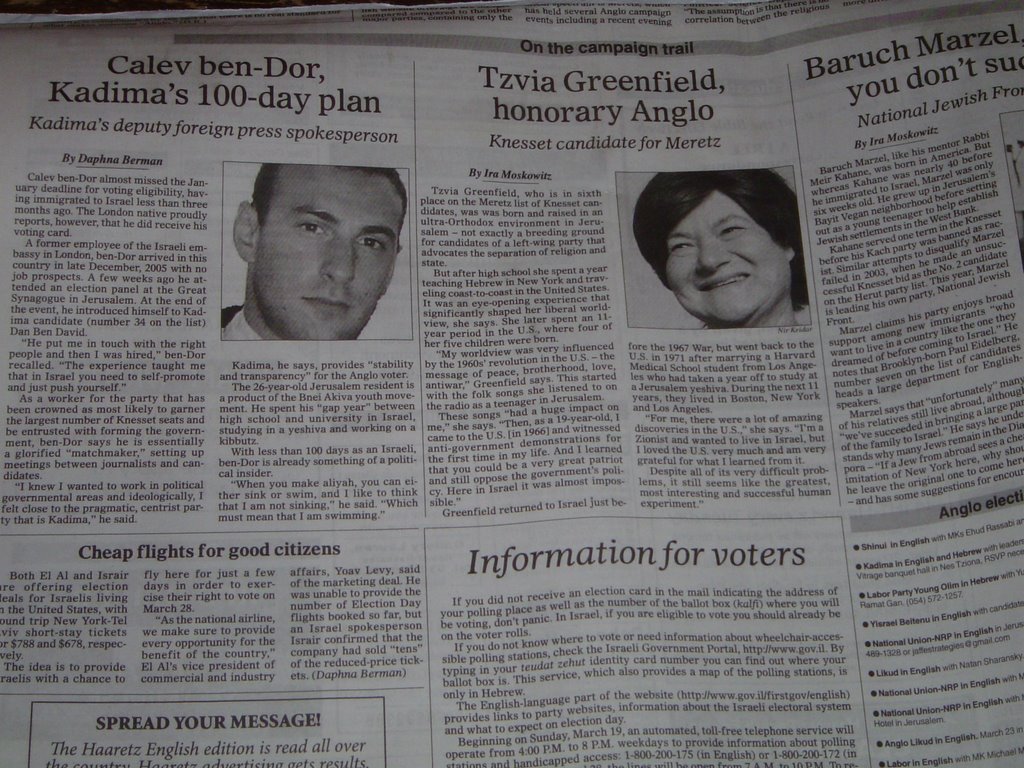
This appeared in Haaretz on Friday as part of a feature on Anglos involved in the election where i am proudly included next to an Ultra Orthodox women who is on the Meretz list and a neo fascist who wants to expel all the Arabs...

and for those interested, the last quote was in response to a question about me diving in the deep end of Israeli life...